

Induction Heating Applications
Cap Sealing
Induction cap sealing is a fundamental process within the packaging industry, engineered to forge a secure bond between a protective foil liner and the periphery of a container.
This precisely formed hermetic seal fulfills multiple critical functions: it provides clear tamper indication, prevents egress of contents, and substantially contributes to preserving product integrity and extending shelf stability. The resulting hermetic seal is vital for product safety and quality assurance, making induction sealing technology a trusted standard across the packaging industry.
How Induction Cap Sealing Works
The process centers on generating a high-frequency electromagnetic field to induce heat within the conductive foil liner beneath the cap. As the container passes beneath the induction coil — the core component of an induction coil heater — the foil rapidly undergoes resistive heating. This thermal energy causes the polymer layer on the foil to liquefy and fuse permanently with the container’s rim, forming what’s known as foil induction sealing.
Why Choose Induction Cap Sealing?
Induction heat sealing delivers:
- Speed – Rapid heating suited to high-speed production lines
- Non-Contact Nature – No physical contact with the container or cap
- Highly Localized Energy Transfer – Minimal thermal exposure to the cap material and enclosed contents
Due to its rapidity, cleanliness, and proven reliability, induction cap sealing remains a preferred method across diverse industrial applications requiring secure, consistent closure.
Process Precision Requirements
Precision and repeatability are critical, since sealing must occur within the extremely short windows typical of high-speed manufacturing lines:
- Inadequate thermal input can lead to seal failures and product leakage
- Excessive heating may deform the packaging substrate
Reliable performance depends on robust power regulation, stable thermal output, and seamless integration with automated production systems — key determinants of induction sealing machine performance.
Advanced CEIA Induction Sealing Systems
CEIA’s high-frequency induction cap sealing systems (induction heaters) are frequently specified for demanding applications due to their:
- Remarkable energy efficiency
- Fine-grained power adjustment capabilities
- Sophisticated control interfaces
Frequently Asked Questions
What is induction cap sealing and how does it work?
Induction cap sealing is a packaging process that bonds a foil liner to a container rim to create a hermetic, tamper-evident seal. The container passes under an induction coil, which generates a high-frequency electromagnetic field. That field heats the foil liner beneath the cap, melting its polymer layer so it fuses to the rim. No physical contact is needed.
What are the benefits of induction sealing for packaging?
Induction sealing gives tamper evidence, leak prevention and longer shelf life. The hermetic bond stops contents from leaking or evaporating and shows clearly if a container has been opened. It also preserves product integrity and stability, which is why it’s standard across the packaging industry for capped containers.
Why does induction sealing need a foil liner?
The foil liner is the part that heats up. It’s conductive, so it responds to the electromagnetic field and generates the heat that melts the polymer layer. Without a conductive foil liner under the cap, the induction coil has nothing to heat and no seal can form.
What causes induction seal failures, such as underheating or overheating?
Seal failures usually come from wrong heat input. Too little heat gives an incomplete bond and leaks, while too much can deform the cap or container. Sealing has to happen in a very short window as each container passes the coil. Precise power regulation, stable thermal output and well-tuned control units keep the result consistent from batch to batch.
Is induction sealing suitable for high-speed, high-volume packaging lines?
Yes. Induction sealing suits high-speed lines because it heats rapidly, doesn’t touch the container and delivers energy in a highly localized way. That limits thermal exposure to the cap and contents while keeping pace with production speed. Fine power adjustment lets the same system handle different cap and liner material combinations.
Preferred Products
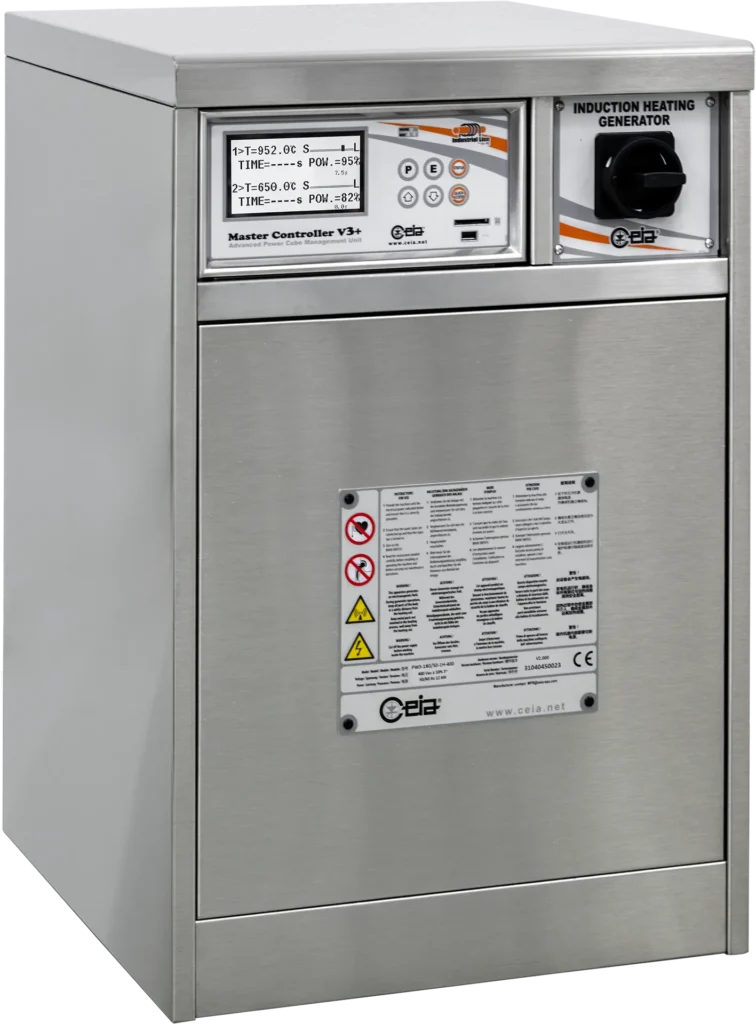
Power Cube Series 200 Generators
The 200 series is the state-of-the-art in medium-high frequency generators available in the market. This family combine the miniaturized CEIA Heating Head solution (patented) with a powerful, continuous-duty rated generator with so high efficiency that it can replace traditional generators in applications up to double input power, thus cutting the initial investment and operating costs.