

Induction Heating Applications
Aluminium Brazing
Aluminium brazing is a critical joining process used to create strong, sealed metal joints without melting the base material. It is widely applied to join tubing, fittings, and thin-walled components where strength, leak-tightness, and dimensional accuracy are essential.
This process plays a vital role in industries such as automotive, HVAC/refrigeration, aerospace, and heavy engineering, where joint performance directly impacts reliability and efficiency.
What is Aluminium Brazing?
Aluminium brazing involves heating a filler alloy above its melting point, while keeping the base aluminium below its own melting point, so the filler flows into the joint by capillary action. Each process is carefully tailored based on the alloy composition, joint geometry, and desired outcome.
Key considerations in aluminium brazing include:
- Solidus–Liquidus Control – Maintaining the narrow gap between base metal and filler melting points
- Oxide Layer Management – Controlling aluminium’s natural oxide film through flux or atmosphere
- Thermal Uniformity – Preventing hot spots that weaken or distort the joint
- Cycle Precision – Following an exact heating and cooling profile for every joint
Key Benefits
- Strong, Airtight Joint Formation
- Minimal Base Metal Distortion
- Precise, Repeatable Heat Application
- Reduced Risk of Overheating Adjacent Zones
- Consistent Joint Quality at Scale
Applications
Aluminium brazing is essential for a wide range of industrial components, including:
- Heat exchangers and radiators
- Refrigerant and HVAC/R tubing
- Automotive cooling system components
- Aerospace tubing assemblies
Why Induction Heating Suits Aluminium Brazing
Induction heating is optimally suited for aluminium brazing by delivering rapid, localized heat through a non-contact methodology. This offers:
- Superior Thermal Management
- Significantly Mitigated Risk of Inadvertent Overheating
This intrinsic capability affirms the suitability when evaluating whether aluminium works effectively with induction heating for sophisticated joining tasks.
CEIA Induction Systems for Aluminium Brazing
When integrated with sophisticated control methodologies, CEIA induction systems (induction heaters) provide:
- Essential Sensitivity
- Consistent Output Stability
- Refined Power Modulation
Such advanced control permits the definition of dynamic thermal profiles and the execution of precise thermal cycles, precisely aligning the heating curve with the specific material and alloy configurations. This exemplifies an optimized design of an induction heater.
Why Choose CEIA for Aluminium Brazing?
This elevated level of control consistently yields:
- High-Quality Brazed Joints
- Exceptional Manufacturing Repeatability
- Active Monitoring for Thermal Divergences
- Full Traceability
- A Reliable Airtight Seal
Frequently Asked Questions
What is aluminium brazing and how does it work?
Aluminium brazing is a joining process that melts a filler alloy into the joint by capillary action while the base aluminium stays solid. The filler melts at a lower temperature than the parent aluminium, so the result is a strong, sealed joint without melting the parts. It is widely used for heat exchangers, radiators and refrigeration tubing.
Why is aluminium harder to braze than other metals?
Aluminium is harder to braze because of its oxide layer and its narrow melting window. The oxide film forms almost instantly in air and blocks the filler from wetting the joint, so flux or a controlled atmosphere is needed. The base metal and filler also melt at close temperatures, so heating has to be tightly controlled to avoid melting the part.
Is Induction heating good for brazing aluminium?
Yes. Induction heating suits aluminium brazing because it delivers rapid, localized, non-contact heat that lowers the risk of overheating the base metal. With aluminium’s narrow margin between filler and base melting points, precise heat control matters. Induction also limits distortion by heating only the joint, and only for as long as needed.
How do you get consistent aluminium brazed joints in production?
Consistency comes from following the same heating and cooling profile on every joint, with a control system that adjusts power precisely and flags temperature deviations. The heating curve can be tuned to each alloy and joint design. Monitoring and traceability then support quality assurance across production runs and high-volume manufacturing.
Are aluminium brazed joints airtight, and where are they used?
Yes. When the process is properly controlled, aluminium brazing produces a reliable, airtight seal. That is why it’s used for heat exchangers, radiators, HVAC/R tubing, automotive cooling components and aerospace tubing. Leak-tightness, joint strength and dimensional accuracy directly affect reliability in these industries.
Preferred Products
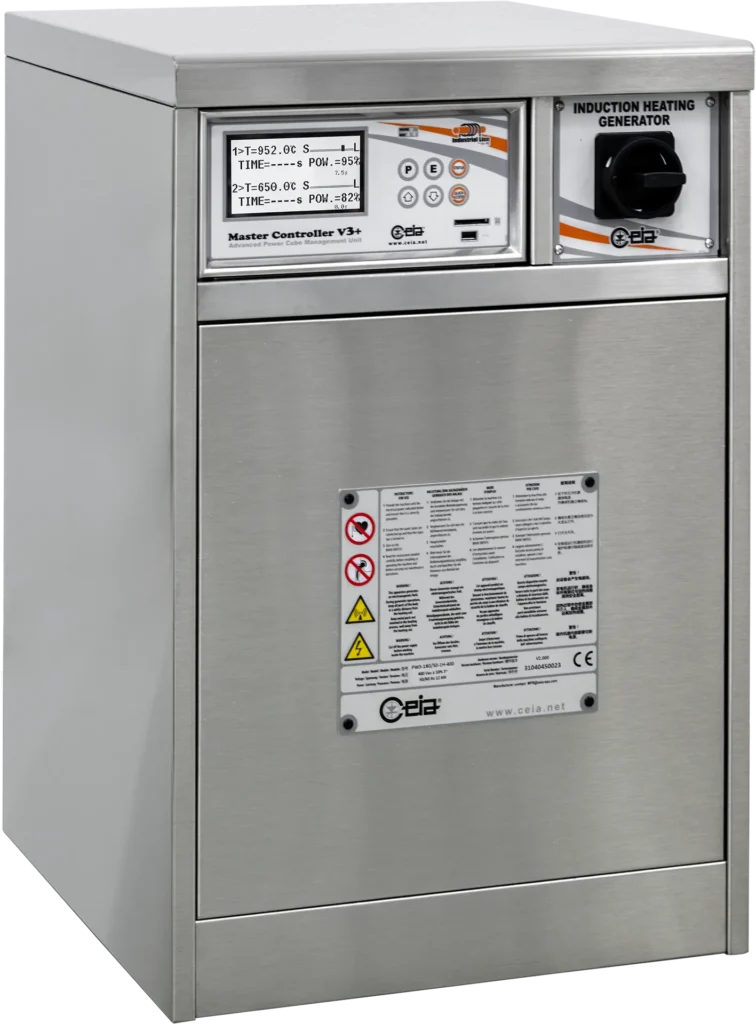
Power Cube Series 200 Generators
The 200 series is the state-of-the-art in medium-high frequency generators available in the market. This family combine the miniaturized CEIA Heating Head solution (patented) with a powerful, continuous-duty rated generator with so high efficiency that it can replace traditional generators in applications up to double input power, thus cutting the initial investment and operating costs.