

Shrink fitting
When seamlessly integrated with CEIA induction heating systems, these processes robustly support enhanced repeatability, maintain consistently stable power output, and effectively mitigate the risk of excessive thermal stress on surrounding materials and sensitive components. The result is a consistently cured bond, coating, or insulating layer, delivered with accelerated cycle times and improved quality control.
Why Choose Induction Heating for Shrink Fitting?
Induction heating is optimally suited for shrink fitting because it delivers:
- Rapid Heating – Curtails production durations and minimizes thermal stress on components
- Highly Localized Heat – Concentrates energy solely within the target area
- Non-Contact Process – Reduces the risk of thermal damage to adjacent components
- Precise Controllability – Enables consistent, repeatable expansion
Unlike conventional thermal processes using ovens or direct flame, induction selectively targets only the designated area — significantly mitigating thermal damage risk and enhancing overall process safety.
Advanced CEIA Induction Heating Systems
When integrated with CEIA Controllers, CEIA Induction Heating Systems (induction heaters) provide:
- Unparalleled Repeatable Performance
- Constant Power Output
- Advanced Real-Time Temperature Monitoring
This empowers operators to meticulously control the heating process profile, ensuring uniform thermal expansion which, in turn, guarantees accurate fits and demonstrably reliable assembly.
Why Choose CEIA for Shrink Fitting?
These highly energy-efficient induction shrink fit systems are designed for seamless integration into existing production lines, adeptly supporting both high-volume manufacturing and specialized single-piece operations — representing a prime induction heating application for precision assembly.
Frequently Asked Questions
What is shrink fitting and how does it work?
Shrink fitting is an assembly process that uses thermal expansion to join two components in a tight interference fit. One part is heated until it expands enough to slip over or into the other. As it cools, it contracts and locks the two parts together without fasteners, adhesives or welding.
How does induction heating work for shrink fitting?
Induction heating rapidly heats only the component that needs to expand, using a coil that doesn’t touch the part. The heated part is fitted over or into its mating component, then cools and contracts into a secure interference fit. Heat stays in the target area, which limits thermal damage to nearby parts.
Induction vs oven or flame for shrink fitting: which is better?
Induction is usually better because it heats only the target area, quickly and under precise control, while ovens and flames heat the whole part or its surroundings. That lowers the risk of thermal damage, shortens cycle times and improves process safety. Rapid heating also limits time at high temperature, which helps preserve material properties.
How do you get a consistent, accurate fit in shrink fitting?
Consistent fits come from repeatable heating: constant power output every cycle and real-time temperature monitoring that keeps expansion uniform. When each part reaches the same temperature profile, it expands by the same amount, so every assembly achieves the same interference fit across a production run.
Is induction shrink fitting suitable for high-volume and single-piece work?
Yes. Induction shrink fitting supports both high-volume production and specialized single-piece operations. Systems can be integrated into existing production lines without major reconfiguration, and their high energy efficiency supports production economics.
Preferred Products
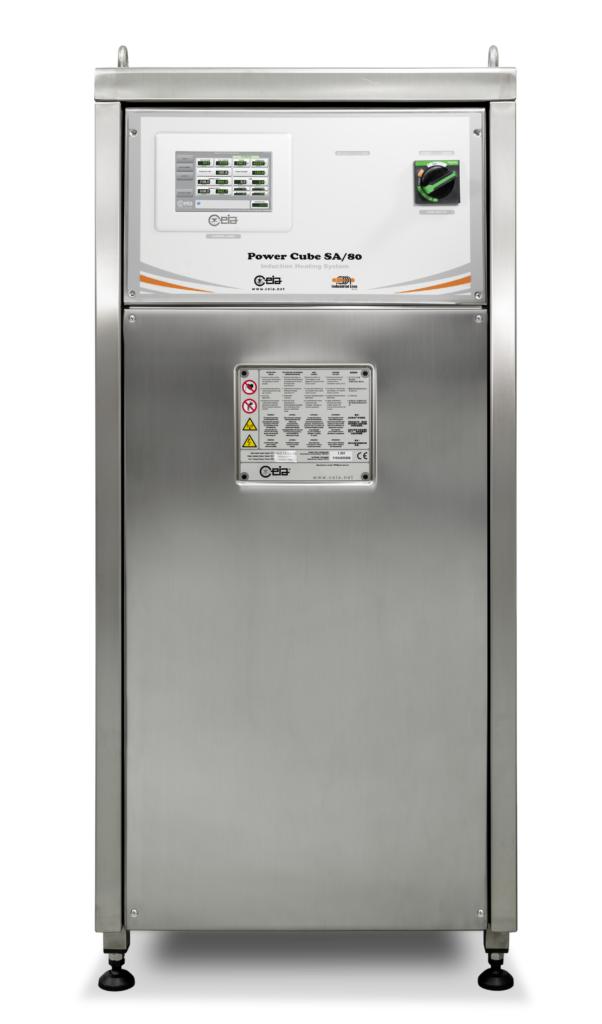
Power Cube SA/80 Series
The SA/80 Generator Series is a high power induction unit in a very compact size with embedded advanced microprocessor based control software and state-of-the-art electronics. This allows very high efficiencies (>96%) under a wide variety of workload conditions while maintaining precise, stable and repeatable output power.